Skip to content

Archive for

Dinner Party Menu: December

Blini with Crème Fraîche and Salmon Caviar
Roasted Tomato and Fennel Soup
Beef Croustades with Boursin and Mushrooms
Chocolate Tart 

Our December menu may come just in time for a celebratory New Year’s dinner. Or, one  or two of the recipes may be just right for a more casual meal.

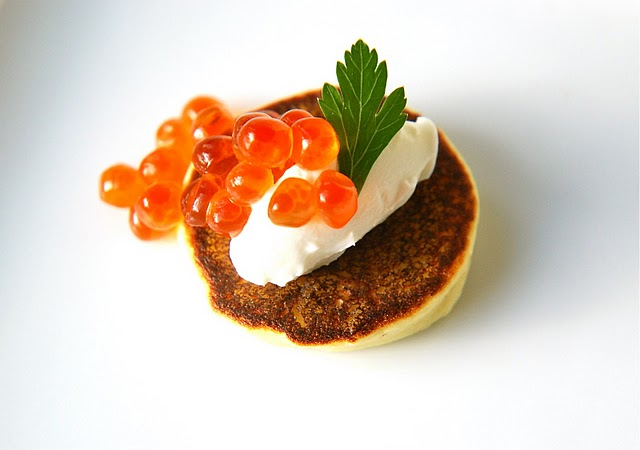
Warm Yukon Gold Blinis with Salmon “Caviar” and Crème Fraîche
This recipe is on Julie’s website where she has many more appetizing ideas.
blini

Photo with thanks to Julie Marr

Just like making pancakes the first blini is a bit of a throwaway, so use it as your learning curve to determine the correct heat level for your pan.  No butter is needed to cook the blinis as long as you use a good quality non-stick pan. You can, of course, use sour cream in place of the crème fraîche, and top with smoked salmon or other fish.

For the blinis:
1 lb. Yukon Gold Potatoes, skins on
2 tablespoons flour
1 tablespoon crème fraîche
2 large eggs
1 large egg yolk
1 to 2 tablespoons of milk
Fine sea salt and freshly ground white pepper

For the garnish:
2 ounces of salmon roe (also called Ikura)
¼ cup crème fraîche
Parsley leaves for garnish (optional)

To make the blinis:
Place the un-peeled potatoes in a medium pot with enough salted water to cover the potatoes. Bring to a boil and simmer until the potatoes are thoroughly cooked. Drain the potatoes and when they are still warm (but cool enough to handle) peel the potatoes and press them through a fine mesh sieve or a potato ricer. Place the potatoes into a medium bowl and quickly work in the flour with a fork and then add it the crème fraîche and mix well. Add the eggs one at a time, followed by the egg yolk and mixing well after each egg is added. Season well with salt and white pepper

At this stage the batter should resemble a somewhat thick pancake batter. If is is really thick then add in 1  to 2 tablespoons of milk to achieve the right consistency.

Preheat a nonstick pan over medium heat and allow it to heat up thoroughly. Spoon about 1 1/2 teaspoons of the batter into the hot pan and allow to cook for approximately 2 minutes and the bottom is golden brown. Flip the blini and allow to cook on the other side for an additional minute.

Remove to a small sheet pan and keep warm is a 200 degree oven while you cook the remaining blinis.

To serve:
Place the blinis on a serving platter and place a dollop (or a small quenelle if you are feeling super fancy) of crème fraîche in the centre of the blini. Place another small dollop of the salmon roe on top and garnish with a sprig of parsley.
Makes 40 canapés.

Roasted Tomato and Fennel Soup
Roasting the vegetables for this soup gives it a deep and rich flavour that improves with time, making it an ideal make-ahead recipe. It can be made 2-3 days in advance. It is healthy but filling, so I recommend serving it in small bowls if you are following this entire menu.

4 lbs. fresh tomatoes, halved lengthwise
6 garlic cloves
1 medium red onion, quartered, not peeled
1 medium-sized fennel bulb, trimmed and sliced into thick wedges
3 tablespoon olive oil
1 teaspoon salt
½ teaspoon pepper
2 tablespoons unsalted butter
1 large shallot, peeled and sliced
1 teaspoon sugar
1 teaspoon fennel seeds
1-14oz. tin diced tomatoes
3½ cups chicken, turkey or vegetable stock (you may need more liquid: if so, add more stock or water)
salt and pepper to taste

Preheat oven to 350°. Put tomatoes, garlic, onion and fennel on a large baking sheet. Drizzle with olive oil and season with salt and pepper. Roast about 1 hour, or until vegetable are soft and slightly caramelized, then cool slightly. Peel the garlic cloves and the onion.

Sauté the shallot, sugar and fennel seeds in butter until the shallot is softened but not browned. Add the tin of diced tomatoes, the roasted vegetables and stock and simmer, covered for 20 minutes. Purée mixture in blender. If soup needs more liquid, add more stock or water. Season to taste with salt and pepper and and garnish with cheese straws, if desired.

tomato-fennel-soup

Photo with thanks to Julie Marr

Beef Croustades with Boursin and Mushrooms
This is a decadent dish, perfect for a special meal. It can be assembled in stages and ready for final baking well in advance. Julie kindly offered her recipe and to demonstrate how it’s done, which I captured on my iPhone.

Mushroom filling:
1 lb. white button or crimini mushrooms, cleaned
2 medium shallots
1 clove garlic, cut in half
2 tablespoons unsalted butter
1 tablespoon olive oil
¼ cup chopped parsley
salt and pepper

Croustades:
6 beef tenderloin steaks 5-6 oz. each, about 1¾” thick
salt
1 tablespoon butter
1 tablespoon olive oil
1 package peppercorn or herb Boursin cheese, slightly softened
1 lb. phyllo dough, thawed in the refrigerator overnight
¼ lb. butter, melted, or more if needed
¼ cup thinly sliced chives

For the filling: Trim the mushroom stems close to the caps. Put the mushrooms, shallots and garlic in a food processor and pulse until finely chopped but not puréed, scraping the bowl as needed. Or, you can chop all of these ingredients by hand if you don’t have a processor. Transfer the chopped mushrooms to the centre of a clean dish towel. Gather up the sides of the towel and twist, keeping the mushrooms well contained in the cloth, bonbon style. With one hand, hold the ball of mushrooms over the sink, and with the other hand, twist the gathered cloth, squeezing out as much liquid as possible.

Heat the butter and oil in a 10” skillet over medium heat. Add the mushrooms, cover, and cook stirring occasionally until the mushrooms are soft and fragrant, 3-5 minutes. Add the parsley and season with salt and pepper to taste. This mixture can be made up to 2 days ahead, covered and refrigerated.

For the croustades: Season the tenderloins generously on all sides with salt. Heat the butter and oil in a sauté pan over medium-high heat until very hot. Put three tenderloins in the pan and sear on one side until browned, 1-2 minutes. Turn and brown the other side. Transfer to a plate lined with paper towels. Repeat with the remaining filets. Cover and refrigerate for at least one hour.

To assemble: Mash the Boursin with a fork in a small bowl until spreadable. Remove phyllo from package and lay the stack on the counter. Take one sheet of phyllo from the stack and cut into 4 squares. Cover the remaining phyllo with a damp dish towel while you assemble each croustade. Brush squares with melted butter and sprinkle with ½  teaspoon of chives.

Make four layers, omitting chives from last layer, with the corners of the phyllo pointing in a different direction, star-like. Blot one tenderloin dry with a paper towel, set it in the centre of the star, and sprinkle it with salt. Spread about 1 tablespoon of the Boursin on the filet and top that with 2 tablespoons of the mushroom filling.

croustade-prep

Pick a starting point and work your way around the filet, gathering the edges of the phyllo star together. Lightly pinch together the gathered phyllo close to the surface of the meat to hold it in place. Pull the corners open slightly as if making a paper flower. Brush the whole exposed surface lightly with more butter being sure that the bottom is buttered as well. Transfer to a heavy baking sheet. Repeat this process for the remaining tenderloins. If you are working ahead, chill the tenderloin packages uncovered on the baking sheet until ready to bake, up to 2 days.

beef-croustade

To bake: Take the croustades out of the refrigerator about 20 minutes before you are ready to bake them. Position the oven rack in the lower third of the oven and heat the oven to 400ºF. Bake the croustades for 17-22 minutes depending on how well done you prefer tenderloin, rotating the baking sheet after 10 minutes to ensure even browning. Serve immediately. Julie served hers on top of roasted carrots and garnished it with quickly sautéed brussel sprout leaves.

croustade-final
Photo with thanks to Julie Marr

Chocolate Tart
This tart can be made 1-2 days ahead and can serve at least 12 people as it is rich and chocolatey. The recipe is slightly adapted from Gjelina, Cooking from Venice, California.

For the crust
1 cup all-purpose flour
½ cup unsweetened cocoa powder
1 cup ground almonds
½ cup ground pine nuts, pistachios or pecans
½ teaspoon Kosher salt
1 cup unsalted butter, room temperature
¾ cup sugar

For the chocolate filling
1 cup unsalted butter
2½ oz. bittersweet chocolate
1½ tablespoons cocoa powder
½ cup packed light brown sugar
½ teaspoon Kosher salt
4 eggs
pomegranate seeds and whipped cream, for garnish

For the crust: In a medium bowl, combine the flour, cocoa, ground almonds, nuts and salt. Set aside.

In a mixmaster fitted with the paddle attachment, beat the butter and sugar on medium speed until fluffy, about 2 minutes. Turn the mixer speed to low and add the flour mixture, and mix until just combined. Transfer the dough to a sheet of parchment paper. Place another sheet of parchment on top and roll out the dough to a ⅛” thick round, 12-13” in diametre. Refrigerate for at least 2 hours, or overnight.

Preheat the oven to 350ºF. Butter a 10” tart pan with a removable bottom. Press the dough into the bottom and sides of the pan. The dough will probably crack, but just press it back together. Bake for 10-15 minutes until firm to the touch. Don’t worry if the crust shrinks down the sides a bit as it bakes. Transfer the pan to a wire rack to let cool. Lower the oven temperature to 325ºF.

For the filling: Set a large heatproof bowl over 1” water in a large saucepan over medium heat. Add the butter and chocolate to the bowl and melt, stirring occasionally, until smooth. Whisk in the cocoa powder, and then add the brown sugar and salt. Continue whisking until the sugar is dissolved and the mixture is shiny. Add the eggs, one at a time, incorporating each one before adding the next.

To bake: Pour the filling into the tart and bake until it puffs up slightly and the surface is shiny, like a brownie. The centre should be just set and does not jiggle when you shake the pan, about 35 minutes. Remove from the oven and let cool in the pan on a wire rack for 40 minutes. Gently remove the sides of the pan.

Slice and serve with some whipped cream and a sprinkle of pomegranate seeds.

chocolate-tart
Photo with thanks to Julie Marr


Dinner Party Menu: November

Crostini with Pickled Mushrooms
Butter Lettuce, Persimmon and Pomegranate Salad with Blue Cheese Dressing and Garlic Chips
Seared and Roasted Lingcod with Roasted Potatoes, Aioli, Pickled Onion and Dill
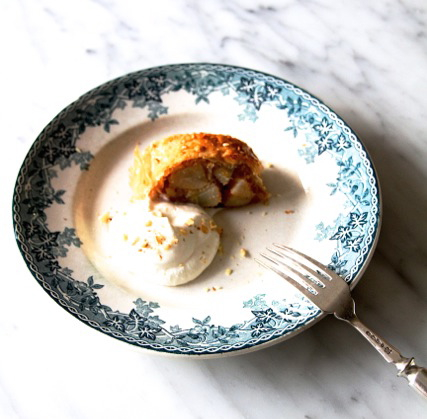
Pear and Cranberry Strudel with Ginger Cream

November (or December in this case) is a good time to make use of mushrooms, persimmons, pomegranates and pears appearing now in our markets. Julie and I each tested this menu with some personal variations.

For the main course I used lingcod, while Julie chose salmon, whack is photographed below. Both are delicious. Julie also added quickly sautéed brussel sprout leaves for a gorgeous presentation. There are several elements to this dish, but the aioli and the pickled onions can be made a few days in advance and the potatoes can be started early in the day of the party and reheated before serving.

The salad and the potatoes are adapted slightly from Gjelina: Cooking from Venice, California by Travis Lett. Julie and I both love this cookbook, especially for its ideas for condiments that jazz up otherwise simple dishes, for example the garlic chips in the salad and the aioli and pickled onions on the potatoes and fish. Any leftover condiments can be used in other ways –  the aioli and pickled onions are great on vegetables and sandwiches.

For the dessert, the ginger cream can be substituted with plain cream or ice cream. But I love the combination of pears and ginger and lately I have made the ginger cream with apple desserts too.

We hope you enjoy this seasonal menu!

Crostini with Pickled Mushrooms
½ cup extra-virgin olive oil
2 pounds mixed mushrooms (oyster, chanterelle and cultivated), cleaned
zest and juice of 1 lemon
3 garlic cloves, sliced
1 teaspoon fresh thyme leaves
½ cup torn Italian parsley leaves
2 bay leaves
Kosher salt and freshly ground black pepper
1 baguette, in ½” slices
½ cup extra virgin olive oil
1 cup cream cheese or ricotta cheese
fresh herbs for garnish (thyme or parsley)

Put ¼ cup olive oil in a large skillet over medium-high heat. Add the mushrooms and cook them for about 3 minutes. Remove from the heat and stir in the lemon zest and juice, garlic, thyme, parsley and bay leaves. Pour over the remaining olive oil and season the mixture with salt and pepper. Pour into a bowl and allow to cool. Store in the refrigerator in a tightly covered glass jar where it will keep for at least one week. Serve at room temperature.

Crostini: Preheat oven to 375ºF. Arrange baguette slices on a large rimmed baking sheet. Brush both sides very lightly with olive oil and season with salt and pepper. Bake until golden, 15 to 20 minutes, turning bread and rotating sheets halfway through. Cool.

To assemble: Spread each crostini with cream or ricotta cheese (it is not absolutely necessary to use cheese, but it does help to “glue” the mushrooms in place), and top with a spoonful of pickled mushrooms. Garnish with fresh herbs and serve.

Note: crackers can be substituted for the crostini, with or without the cheese.

pickled-mushrooms

Butter Lettuce, Persimmon and Pomegranate Salad with Blue Cheese Dressing and Garlic Chips
1 cup buttermilk
6 oz. soft blue cheese, such as St. Augur, room temperature, plus more for garnish
1 clove garlic, minced
1 shallot, minced
¼ cup extra virgin olive oil
2½ tablespoons red wine vinegar
1 tablespoon Worcestershire sauce
salt and pepper to taste
garlic chips (recipe below)
1-2 heads butter butter lettuce, separated at the stem, inner smallest leaves to be used
1 Fuyu persimmon, peeled, sliced and quartered
¼ cup pomegranate seeds

Dressing
In a food processor or in a medium bowl, combine the buttermilk, blue cheese, garlic, shallot, olive oil, vinegar and Worcestershire sauce. Mix until almost smooth and add salt and pepper to taste. Add more buttermilk or cheese if necessary to   ensure the dressing is thick enough to coat the lettuce but not so thick that it drowns it. Pour into a jar and refrigerate until ready to use. Dressing will keep for several days.

Garlic Chips
2 heads garlic, separated and peeled (elephant garlic works well for this recipe)
2 cups extra virgin olive oil or grapeseed oil

Thinly and evenly slice garlic cloves, then rinse in a sieve under cold water for about 2 minutes. Dry on a kitchen towel, drawing out as much water as possible.

In a small saucepan, heat the oil over medium heat until shimmering. Carefully add the garlic slices and cook, stirring constantly, until garlic is light golden brown, lowering the heat if necessary to keep the garlic from burning. Remove garlic with a slotted spoon to a paper towel-lined plate to drain. Let the oil cool to room temperature.

Store the garlic in an airtight container at room temperature for up to 3 days. Pour the oil into a jar and store in the refrigerator for up to a week. Makes 1 cup garlic chips and 1½ cups garlic oil.

To serve salad: Put the lettuce leaves into a large bowl and toss with just enough dressing to lightly coat the leaves. Season with salt and pepper. Arrange on a platter or on individual plates and garnish with the persimmon, pomegranate seeds, garlic chips and a little crumbled cheese. Serves 6

persimmon-salad-nov

Photo with thanks to Julie

Seared Lingcod with Roasted Potatoes, Aioli, Pickled Onion and Dill
1½ lb. baby or fingerling potatoes (mixed colours, if you can find them)
Kosher salt
freshly ground black pepper
¼ cup extra virgin olive oil
juice of ½ a large lemon
½ cup aioli (recipe below)
¼ cup fresh dill sprigs
a few tablespoons of pickled onions (recipe below)

Combine potatoes with water to cover in a large pot, season with salt, bring to a boil and simmer until potatoes are just tender. Drain and cool on a baking sheet. When cool enough to handle, cover one potato at a time with plastic wrap and smash it gently with the palm of your hand. The potatoes will be irregular in shape but should be similarly flat.

Heat a large sauté pan over high heat, add oil and then add as many potatoes as will fit in a single layer. Sear until browned and crisp, 4-5 minutes. Turn and cook the other side, about 3 minutes. Transfer to a serving platter and repeat with all of the potatoes and season them with salt and pepper.

Lingcod
6-5oz. pieces of lingcod (ask the fish monger to cut even pieces, 2” thick)
salt and pepper
2 tablespoons of olive oil

Preheat oven to 400ºF. Season lingcod with salt and pepper. Heat olive oil in a heavy sauté or grill pan over high heat. Add the fish and brown well on one side, about 5 minutes. Turn fish, place in the oven and roast until just done, about 3-5 minutes, depending on thickness. Fish is done when just opaque. If using salmon, leave the skin on and sear and roast as described, starting with the skin side down. Plate with skin side up.

To plate: Place warm potatoes in the middle of each plate, squeeze lemon juice over them, and place seared fish on top. Top each portion with a spoonful of aioli and pickled onions. Garnish with dill. Serves 6

Aioli
3 garlic cloves, chopped
1 large egg
1 tablespoon freshly squeezed lemon juice
½ teaspoon salt
freshly ground black pepper
¼ cup olive oil
¼ cup canola or grapeseed oil

Combine the garlic, egg, lemon juice, salt and pepper in a food processor or blender and purée. Add the oils in a slow stream and continue to process until the mixture has formed a thick emulsion. Refrigerate until ready to serve. Can be made up to 2 days ahead.

Pickled Red Onions
3 cups water
1¼ cups red wine vinegar
1 tablespoon cumin seeds
1 tablespoon yellow mustard seeds
1 teaspoon black peppercorns
5 sprigs fresh thyme
1 bay leaf
3 tablespoons plus 1 teaspoon sugar
2 tablespoons plus 1 teaspoon Kosher salt
2 pounds red onions, thinly sliced

Make the brine: Combine the water, vinegar, seeds, peppercorns, thyme, bay leaf, sugar and salt in a medium saucepan. Bring to a boil then lower hear and simmer 3-4 minutes. Remove from the heat and steep for 20-30 minutes, then cool to room temperature.

Into a 2 quart glass jar pack the sliced onions. Pour the brine over them and let sit at room temperature for 1 hour. Onions can then be used or stored in the refrigerator, tightly sealed, for up to one month.

seared-fish-nov

Photo with thanks to Julie

Pear and Cranberry Strudel with Ginger Cream
3 large pears, peeled, cored and cut into 1” chunks
2 tablespoons lemon juice
4 tablespoons sugar
8 tablespoons unsalted butter
2 tablespoons dried cranberries
4 tablespoons dry bread crumbs or panko, divided
¼ teaspoon ground allspice
¼ teaspoon ground ginger
6 sheets phyllo dough
½ cup finely chopped toasted almonds, plus more for garnish if desired
icing sugar, for dusting
ginger whipped cream, for serving

Toast the almonds, chop coarsely and set aside.

In a medium bowl, toss pears with lemon juice and 2 tablespoons of sugar.

Clarify the butter: Melt the butter in a small saucepan over medium heat. Set aside to cool, then skim the foam off the surface and discard. Pour melted butter into a bowl, leaving the solids behind in the saucepan.

Heat 2 tablespoons of the clarified butter in a non-stick sauté pan over medium-high heat. Add pear mixture and cook until pears start to give off juices. Add the cranberries, cover, and reduce heat. Simmer just until pears are crisp-tender. Remove from the heat and stir in 2 tablespoons of bread crumbs. Cool mixture slightly.

Preheat oven to 400ºF.

Combine remaining 2 tablespoons sugar with allspice and ginger in a small bowl and add the chopped almonds. Cut a piece of parchment paper slightly longer than the phyllo sheets and lay it with a long edge parallel to you. Set the stack of phyllo sheets beside it and cover with a clean kitchen towel. Transfer one sheet of phyllo to the parchment with a long edge facing you. Brush with some reserved butter and sprinkle with 1 teaspoon each of the nuts and sugar mixture. Repeat with remaining 5 sheets of phyllo, adding butter, sugar and nuts to next 4 layers.  Sprinkle last layer with remaining 2 tablespoons of bread crumbs.

Spoon the pear mixture across the phyllo about 1” from the edge closest to you to make a mound, with a 2” border at each end. Using the parchment to help, roll the phyllo tightly over the filling to a make a log, seam-side down. Lift the parchment with the strudel onto a baking sheet. Brush with any remaining butter.

Bake until golden, about 30 minutes. Transfer on the baking sheet to a rack to cool. Trim ends with a serrated knife and dust with icing sugar. Serve warm or at room temperature with ginger cream and a sprinkling of chopped nuts if desired.

Ginger Cream
¼ cup water
3 tablespoons mince peeled ginger
2 tablespoons sugar
1 cup chilled whipping cream

Combine water, ginger and sugar in a heavy small saucepan. Stir over medium heat until sugar dissolves, then simmer until syrupy, about 5 minutes. Cool completely. Beat cream until soft peaks form, then fold in the ginger mixture. Can be made 4 hours ahead, covered and chilled.

pear-strudel-nov

Photo with thanks to Julie